
Curiosity Comes First in Cross-Cultural Dating

Clear questions, honest answers and practical advice for dating across cultures in Tāmaki Makaurau.

You are halfway through a good first date when a small question suddenly feels rather large. Should you offer to pay? Is meeting someone’s family a casual invitation or a serious step? Was the quiet goodbye reserved, respectful or simply a sign that the spark was not there?

Among Auckland singles, these moments are common. Tāmaki Makaurau brings together Māori, Pasifika, Asian, migrant and returning-expat communities, along with people whose families have lived here for generations. That variety makes dating interesting, but it also means your own idea of what is “normal” may not travel far beyond your household.

What makes cross-cultural dating in Auckland work?

Cross-cultural dating works best when both people replace assumptions with specific, good-natured questions.

Culture matters. So do age, faith, personality, family history, sexuality, previous relationships and how long someone has lived in Auckland. No single label tells you how a person approaches affection or commitment. Two people from the same community can hold completely different expectations, while people from distant backgrounds may discover that their values line up neatly.

Treat culture as useful context, not a set of instructions for reading another person.

Curiosity helps when it sounds like interest rather than an interview. “What does dating usually look like in your family?” gives someone room to explain. “People from your culture are quite traditional, aren’t they?” asks them to defend or reject a stereotype before you have even heard their view.

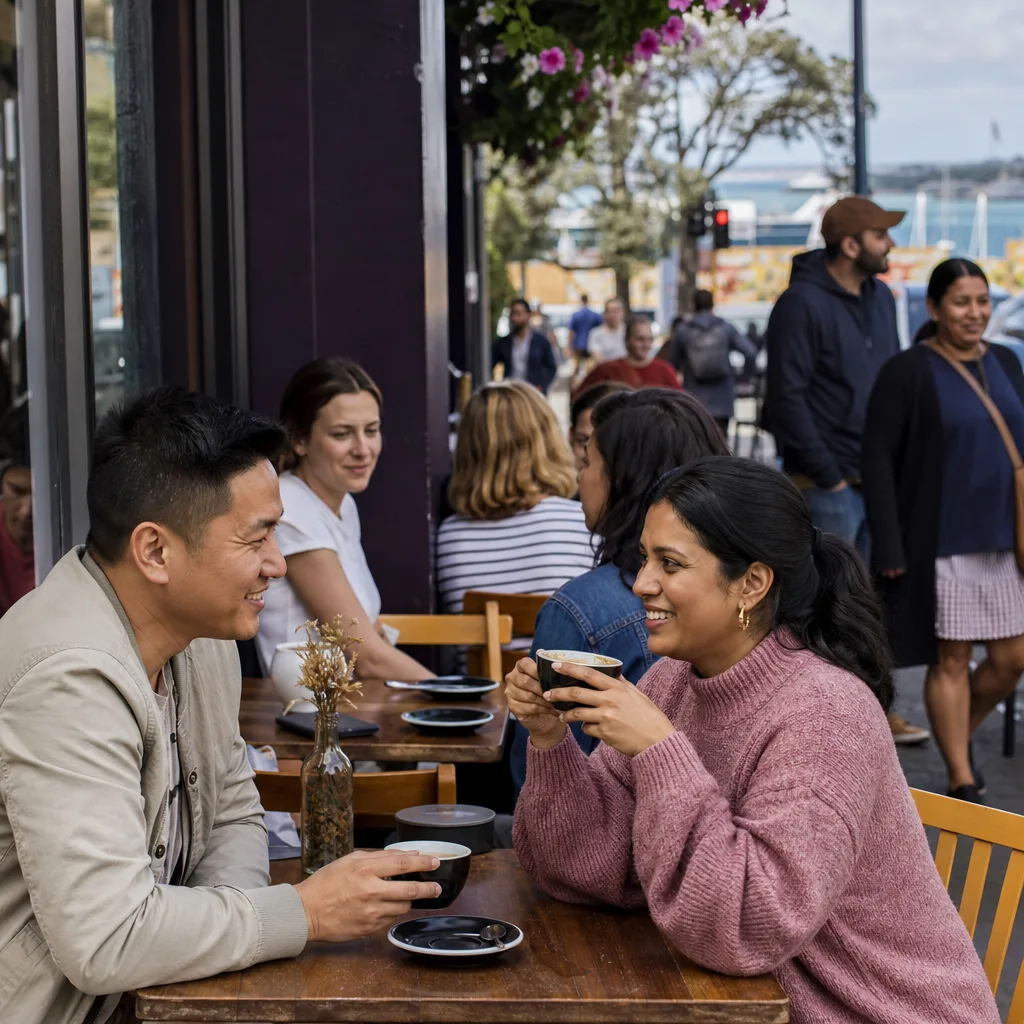
Two Auckland singles sharing lunch and an easy conversation

The awkward topics are often the useful ones. Family involvement, public affection, money, gender roles and the meaning of commitment can sit quietly beneath a new relationship until somebody breaks an unwritten rule. Better to bring them into daylight, a little at a time.

How do you talk about different dating expectations?

Use open questions, explain your own preferences plainly and check that you have understood the answer.

You do not need a formal summit on date one. Start with whatever is relevant. If someone mentions a family lunch, ask whether partners are normally included. If you prefer to split the bill, say so without presenting it as the only modern or fair choice. Clear communication is not bluntness. It is simply giving the other person something solid to respond to.

TopicA useful questionWhat to clarify
Family“How involved is your family when you are seeing someone?”Privacy, introductions and family responsibilities
Affection“Are you comfortable holding hands or kissing in public?”Personal boundaries and appropriate settings
Money“Would you like to split this, or take turns?”Practical expectations without guessing
Gender roles“What feels fair to you when planning dates or sharing responsibilities?”Actual preferences rather than inherited assumptions
Commitment“What does being exclusive mean to you?”Timing, labels and contact with other dates

Listen for the individual answer. A Māori date may describe strong obligations to whānau, but what those obligations mean varies widely. A Pasifika person may be closely connected to family or church, yet it would be careless to assume either. “Asian” covers many countries, languages, religions and family histories. It is far too broad to predict who chooses a partner, who pays or how affection is shown.

Culture never excuses control. Pressure to share passwords, cut off friends, accept unwanted physical contact or hand over money is not a cultural misunderstanding. It is a boundary problem. Step back, tell someone you trust and use the site’s reporting tools where appropriate.

A couple walking through Auckland Domain near the museum

Misunderstandings are rarely solved by collecting facts about somebody’s background and trying to fit them to a pattern. Think of that knowledge as a map drawn at street level: useful for orientation, but it cannot tell you which front door is theirs.

What should you do when a cultural misunderstanding happens?

Pause, describe what happened without accusing, and ask what the moment meant to the other person.

  1. Name the moment. Say, “I noticed we seemed uncomfortable when the bill arrived,” rather than making a claim about what their culture expects.
  2. Explain your reading. Offer your interpretation as one possibility: “I wondered if my suggestion to split it sounded unfriendly.”
  3. Ask for theirs. Give them room to explain their intention, family habits or personal preference.
  4. Agree on next time. A practical arrangement is more useful than deciding whose custom is correct.

Sometimes the explanation will be cultural. Sometimes they were tired, nervous or short of money. Sometimes the two of you simply want different things. Respect does not require agreement, and cultural sensitivity does not mean staying in a relationship that feels wrong.

Try a date that leaves room to talk. Auckland War Memorial Museum sits in Auckland Domain and gives you plenty to discuss without forcing constant eye contact. A ferry trip to Devonport can work well too, especially when both people live near a terminal. Check the last sailing before you settle in somewhere.

Location matters in cross-cultural dating Auckland wide for an ordinary reason: time. Someone in Albany and someone in Manukau may share values but struggle to manage a Tuesday evening. Before reading slow replies as disinterest, ask about shifts, caregiving, church or community commitments, and the commute. Then make a plan that is fair to both people.

Friends from different Auckland communities talking at an outdoor gathering

Family can be the point where private dating meets a much bigger circle. For some single people Tāmaki Makaurau wide, a family introduction carries weight. For others it is simply what happens when relatives live nearby, share meals often or help with children and elders.

When should you meet each other’s family?

Meet family when you both understand what the introduction signifies and feel ready for the level of attention it may bring.

Ask before accepting or declining. “Would this feel serious to your family?” is better than assuming an invitation means engagement is around the corner. If you come from a background where partners meet relatives casually, explain that too. The aim is not to rank one approach above another. It is to prevent two people walking into the same room with entirely different ideas about why they are there.

  • For Māori singles. Ask how your date speaks about whānau, whakapapa and responsibilities rather than presuming every family follows the same tikanga or has the same level of connection with te ao Māori.
  • For Pasifika singles. Family, faith and community may be central, loosely connected or not personally important. Let your date define those relationships in their own words.
  • For Asian singles. Avoid treating a continent as one culture. A New Zealand-born Chinese person, a recent Filipino migrant and a returning Korean expat may have very different views on family approval and independence.
  • For newer migrants. Limited local networks can make a relationship feel intense quickly. Keep your own friendships and routines while trust develops.
  • For returning expats. Familiar streets do not always mean familiar social rules. Friends may have partnered up, family expectations may have shifted and dating in Auckland may feel surprisingly new.

Multicultural relationships also involve ordinary negotiation: whose celebrations to attend, what food is served, which language is used with relatives and how children might be raised. Those questions need not all be settled early. But if marriage, faith or children are non-negotiable for either person, say so before affection does all the decision-making.

A respectful relationship is not one where nobody gets anything wrong. That would be impossible. It is one where both people can ask, correct and clarify without being mocked or made responsible for explaining an entire community.

How can you meet culturally diverse singles nearby?

Start with local profiles, state what matters to you and suggest a public meeting place that is genuinely convenient for both people.

Your profile does not need a manifesto. A few specific lines are enough: whether family is a large part of your life, whether faith matters, what sort of relationship you want and which part of Auckland you can realistically reach. Browse singles near you, or read more about dating in Auckland before making contact.

Then ask a real question. Stay open, but keep your standards. Curiosity and respect work together only when honesty is present too.

Frequently asked questions

Is it rude to ask someone about their cultural background on a date?

Not if the question is relevant, respectful and leaves room for the person to answer in their own way. Ask about their experience rather than requesting an explanation of an entire culture. Share something about yourself as well, so the conversation does not feel like an interview.

What if our families have very different expectations?

First identify the actual difference. It may concern introductions, religion, marriage, money or family involvement. Decide together what boundaries you can hold and where compromise is realistic. If one person expects the other to hide the relationship indefinitely or abandon important values, affection alone may not resolve it.

How can I discuss affection and gender roles without causing offence?

Speak from your own perspective and ask for theirs. Try, “I prefer to take turns planning and paying. What works for you?” or “I am comfortable with hand-holding, but I like to take other affection slowly.” Consent and fairness should be discussed directly, not guessed from somebody’s background.

Meet Auckland Singles Who Live Within Reach

Create a local profile, be clear about what matters to you and start with a straightforward conversation.

Join Date Auckland Singles